
28 August 2026
➤ Malaysian bond market experienced heightened volatility in the month of August 2026, with the bond market registering (0.42%) for the month. This is the 2nd month this year that the market registered negative performance, the first being March when the US-Iran war broke out. Year-to-date, the market registered performance of 0.61%, a dismal performance compared to 2025 whole year performance of 5.65%.
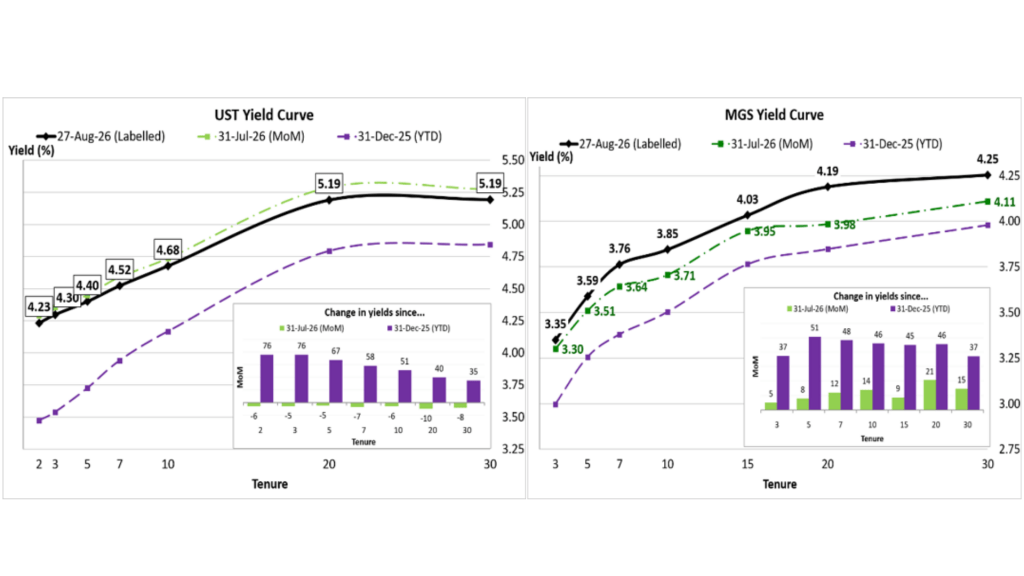
➤ In the last month, the Malaysian Government Securities (MGS) yields shifted upwards by 5 – 20 bps across the curve, with a steepening bias on the longer end. The upward shift is due to elevated U.S. Treasury yields, domestic political noise and concerns surrounding the absorption of long-term government bond supply.
➤ The upward movement in domestic yields was largely influenced by global bond market developments. The 10-year U.S. Treasury yield increased to 4.70% as at 27 August, while the 30-year yield remained elevated at 5.25%, reflecting inflation concerns arising from high oil prices, increased liquidity requirements associated with AI-related investment and persistent concerns surrounding the U.S. fiscal position and Treasury supply. Although the U.S. Treasury’s debt-buyback announcement provided temporary relief to ultra-long yields, the rally subsequently faded as the U.S. budget deficit widened to USD432.3 billion in July, reinforcing concerns over future funding requirements.
Chart 1: UST and MGS Yields remains elevated across all tenors, reflecting renewed global duration pressure and long-end supply (Source: Bloomberg. BPAM)
- Malaysia Government bond supply also contributed to the cautious market tone. Gross MGS and Government Investment Issues (GII) issuance in August was RM20.0 billion compared to RM15.0 billion in July. However, the auction demand continued to indicate that underlying institutional appetite remained intact, although investors required higher yield concessions to absorb longer-dated government securities. The remaining supply until the end of year may continue to exert modest pressure on the belly and long-end of the yield curve.
- Corporate bonds and sukuk were also broadly softer alongside higher government bond yields, although credit fundamentals remained resilient. New issuance of corporate bond and sukuk with higher yields have also resulted in the higher mark to market valuation of secondary papers. While this negatively impact valuation of secondary papers, on the positive side, high-quality papers such as CIMB, YTL, Gamuda has come out to issue at more attractive yields.
- Malaysia’s positive real yields, moderate inflation and relatively resilient Ringgit should continue to support foreign demand for local government bonds. Nevertheless, foreign investors are likely to remain selective, with demand concentrated in liquid MGS benchmarks and shorter to medium-duration securities until global yields and long-term domestic supply conditions become more favourable.
- Looking ahead, Malaysian government bond yields are expected to remain range-bound with a modest upward bias in the near term, reflecting elevated global yields, domestic issuance requirements and higher term premium at the long-end of the curve. The front-end should remain anchored by expectations for Bank Negara Malaysia to maintain the OPR at 2.75%, while the 10-year to 30-year segments may continue to experience higher volatility due to global inflation expectations, fiscal concerns and long-duration supply. Nevertheless, the balance of risks may turn more favourable if U.S. labour market conditions weaken further and global bond yields moderate from their recent highs.
Outlook and Strategy
➤ We expect Bank Negara Malaysia to retain the Overnight Policy Rate at 2.75% through the remainder of 2026, underpinned by resilient domestic economic activity and manageable inflation. While the stronger growth environment reduces the urgency for monetary policy easing, contained headline and core inflation should limit the need for policy tightening. The front-end of the yield curve is therefore expected to remain relatively anchored, while the belly and long-end may continue to reflect movements in U.S. Treasury yields, domestic issuance conditions and higher term premium requirements.
➤ Consequently, we maintain a cautiously constructive view on Malaysian Fixed Income. We look to shorten durationto below 5 years to mitigate against external yield shocks and long-end supply volatility. We remain positive on credit and see opportunities in investing in high-quality corporate bonds at higher yields without taking too much duration risk. We aim to increase portfolio yields to above 4.0%, which will give us a higher and consistent return while prioritising capital preservation.
Disclaimer
The information, analysis and opinions expressed herein are for general information only and are not intended to provide specific advice or recommendations for any individual entity. Individual investors should contact their own licensed financial professional advisor to determine the most appropriate investment options. This material contains the opinions of the manager, based on assumptions or market conditions and such opinions are subject to change without notice. This material has been distributed for informational purposes only and should not be considered as investment advice or a recommendation of any particular security, strategy or investment product. Information provided herein may include data or opinion that has been obtained from, or is based on, sources believed to be reliable, but is not guaranteed as to the accuracy or completeness of the information. No part of this material may be reproduced in any form, or referred to in any other publication, without express written permission. Opus Asset Management Sdn Bhd and its employees accept no liability whatsoever with respect to the use of this material or its contents.